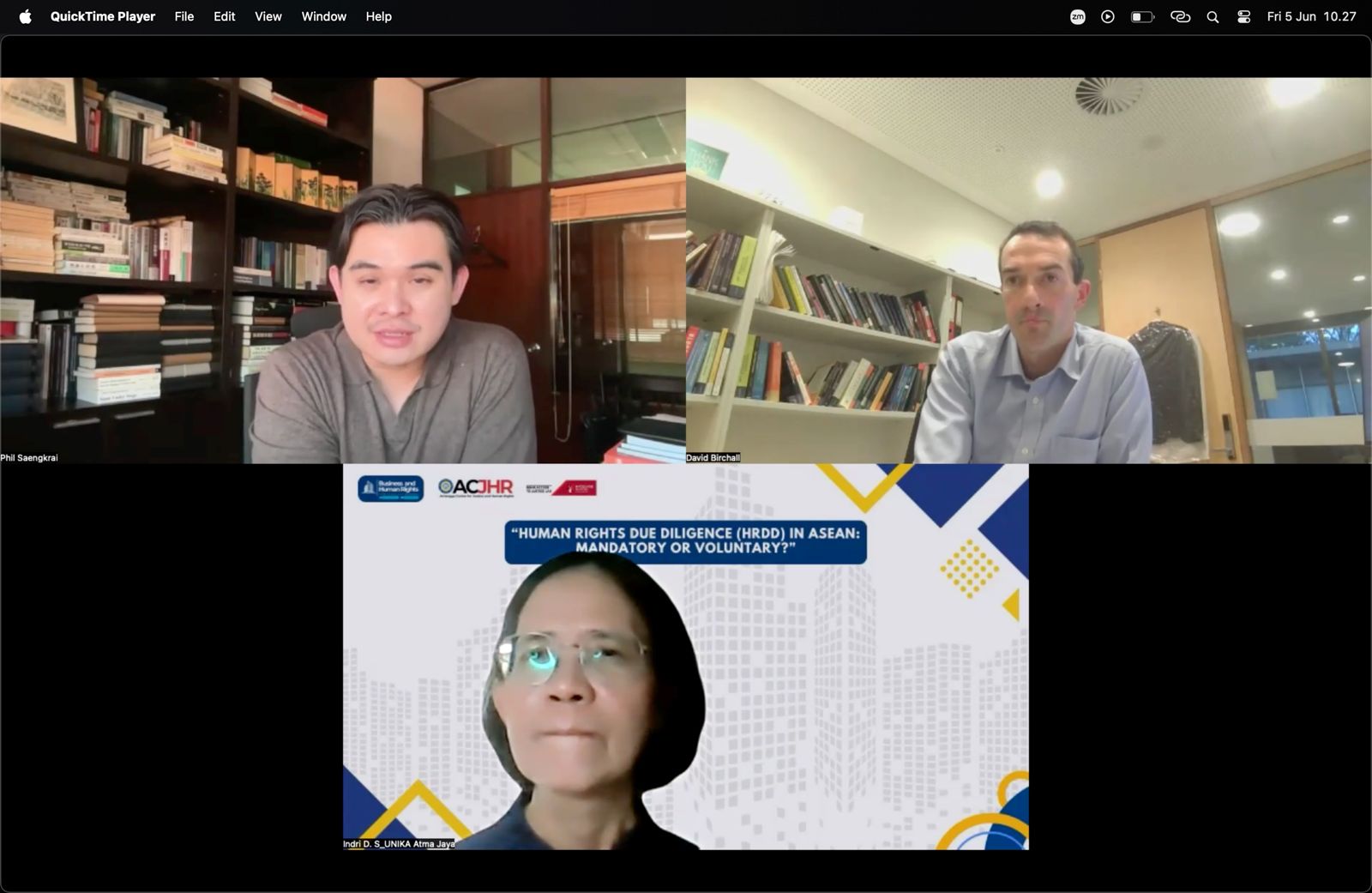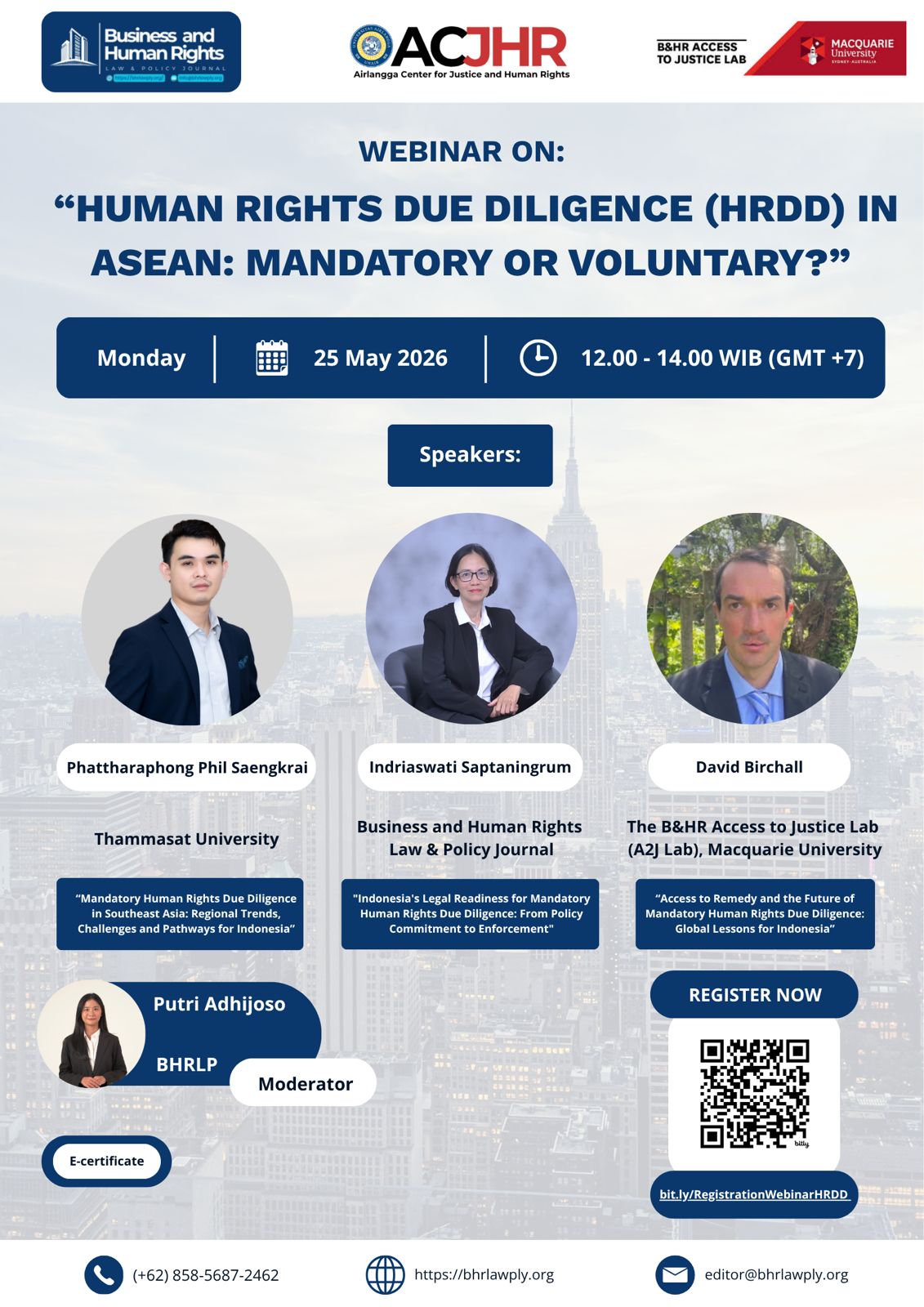
Webinar on: “Human Rights Due Diligence (HRDD) in ASEAN: Mandatory or Voluntary?”
Monday, 25 May 2026
Human Rights Due Diligence (HRDD) has emerged globally as a key framework to ensure that businesses respect human rights across their operations and supply chains. The framework is grounded in the United Nations Guiding Principles on Business and Human Rights (UNGPs), endorsed by the United Nations Human Rights Council in 2011.
Globally, several jurisdictions have begun adopting mandatory HRDD legislation, including the European Union through the Corporate Sustainability Due Diligence Directive (CSDDD), and individual countries such as Germany and France. These developments raise important questions for Indonesia, particularly given its role in global supply chains (e.g., palm oil, mining, manufacturing, and digital economy sectors).
In Indonesia, business and human rights discussions are evolving, with initiatives linked to the National Strategy on Business and Human Rights (STRANAS BHR). However, HRDD remains largely voluntary. The debate now centers on whether Indonesia should move toward a mandatory HRDD framework or maintain a voluntary, incentive-based approach. This webinar aims to foster informed dialogue among policymakers, businesses, civil society, academia, and development partners.
1. Organizers
This webinar is jointly organized by:
- Business and Human Rights Law & Policy (BHRLP) Journal
- The B&HR Access to Justice Lab (A2J Lab) at Macquarie University
- Airlangga Center for Justice and Human Rights (ACJHR)
The collaboration reflects a shared commitment to advancing research, dialogue, and policy development on business and human rights, particularly in the Indonesian and Asia-Pacific context.
2. Objectives
The webinar seeks to:
- Provide an overview of global HRDD trends and regulatory developments.
- Assess Indonesia’s current legal and policy framework relating to business and human rights.
- Explore the advantages and disadvantages of mandatory versus voluntary HRDD.
- Identify potential legal, economic, and social implications for Indonesia.
- Generate policy recommendations and practical next steps.
3. Key Discussion Questions
- What is HRDD and how is it implemented under the UNGP framework?
- What lessons can Indonesia learn from mandatory HRDD regimes in other jurisdictions?
- Would mandatory HRDD enhance legal certainty and investor confidence?
- What are the potential compliance costs and impacts on SMEs?
- How can voluntary mechanisms be strengthened if a mandatory regime is not adopted?
- What institutional reforms would be required in Indonesia to implement mandatory HRDD?
4. Target Participants
- Government representatives (Ministry of Law and Human Rights, Ministry of Trade, Ministry of Investment/BKPM, etc.)
- Members of Parliament
- Corporate leaders and business associations
- Civil society organizations and human rights advocates
- Academics and researchers
- International development partners
- Students and the general public
Speaker 1: Phattharaphong Phil Saengkrai (Thammasat University)
Theme: “Mandatory Human Rights Due Diligence in Southeast Asia: Regional Trends, Challenges, and Pathways for Indonesia”
Focus Areas:
- Developments on business and human rights frameworks in Southeast Asia
- Comparative regulatory approaches within ASEAN member states (Thailand)
- Regional economic integration and supply chain implications
- The role of National Action Plans (NAPs) in advancing HRDD
- Strategic considerations for Indonesia within the ASEAN context
This theme is to provide a regional comparative perspective, enriching the discussion beyond Europe-focused developments and situating Indonesia within broader Southeast Asian dynamics.
Speaker 2: Indriaswati Saptaningrum (Business and Human Rights Law & Policy Journal)
Theme: “Indonesia’s Legal Readiness for Mandatory Human Rights Due Diligence: From Policy Commitments to Enforcement”
Focus Areas:
- Indonesia’s existing regulatory framework relevant to corporate human rights responsibility
- Gaps between voluntary commitments and enforceable obligations
- Institutional capacity and regulatory coordination challenges
- Implications for state-owned enterprises and domestic corporations
- Practical legal reform pathways toward (or alternatives to) mandatory HRDD
Speaker 3: David Birchall (The B&HR Access to Justice Lab (A2J Lab), Macquarie University)
Theme: “Access to Remedy and the Future of Mandatory Human Rights Due Diligence: Global Lessons for Indonesia”
Focus Areas:
- The relationship between HRDD and access to justice for affected communities
- Gaps in voluntary frameworks in ensuring effective remedies
- Comparative insights from emerging mandatory HRDD regimes
- The role of courts, grievance mechanisms, and regulatory oversight
- Key design considerations if Indonesia were to adopt mandatory HRDD
This theme is to bring a strong comparative and access-to-justice perspective, complementing domestic legal, business, and civil society viewpoints.
REGISTRATION: bit.ly/RegistrationWebinarHRDD
CP: Andra (+62) 858-5687-2462